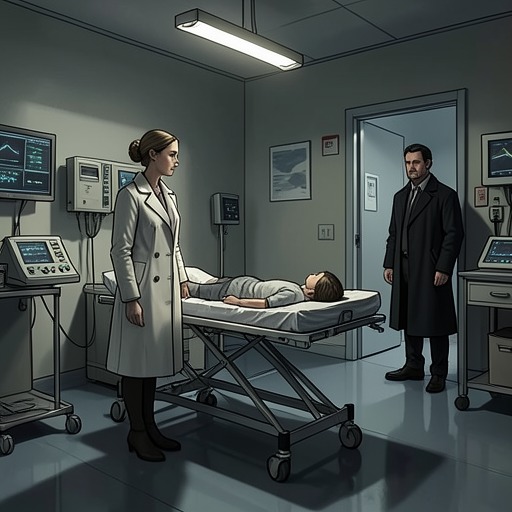
You Have Purpose
I'm Still Here- What didn't kill me made me stronger and sharper“You Have Purpose” is the novel’s recurring answer to the question of why Jensen Brick McCall survived when others did not. The phrase begins as an assurance from family and the woman who rescues him as a newborn, but survival does not immediately make its meaning clear: Jensen grows up surrounded by loss and asks what purpose can mean in a life marked by abandonment. Its significance lies in that tension between being told that life has a reason and having to endure before any reason becomes visible.
A Promise First Spoken by Family
Jensen’s uncle Khalid gives the phrase its first explicit form when Jensen confides that he feels like the wrong person was chosen to live. Khalid answers, “Allah, chose you to live because you have purpose.” The statement offers a spiritual explanation for survival, but not an account of what Jensen is supposed to do. Jensen does not yet know what purpose means; even dreaming, imagination, and feeling different seem like burdens rather than gifts.
Khalid’s further counsel changes the emphasis from a mysterious destiny to capacities Jensen can actually use. He encourages Jensen to embrace being a dreamer and imagines that his imagination will help him create books. Jensen later connects that advice to his writing: stories give him a way to hold on to hope and faith, and to offer readers something valuable. The phrase therefore grows beyond reassurance about why Jensen remains alive; it begins to describe what he might make of that life.
Survival Made Concrete at Birth
The promise becomes an immediate decision in the account of Jensen’s infancy. After a woman involved in the care of failed abortions is told to let the baby die, she refuses. Holding him, she sees his smile and feels his fingers close around her thumb; she says, “You have purpose little brown baby. I guess God wants me to take care of you.” She takes him home and names him Jensen Brick McCall. Here, purpose is not a distant prediction but a reason to act: the baby’s survival depends on someone choosing to protect him.
That rescue carries a painful contradiction. The woman later explains that babies rarely survive a botched abortion and live in good health, and she presents Jensen’s survival as evidence that he is destined for something great. Yet she also tells him that God chose him for a purpose without knowing what it is. Her certainty about the importance of his life does not amount to certainty about its meaning. Before her death, her words leave Jensen with an inheritance that is both sustaining and unresolved: he has been saved, but he must still discover what the promised purpose asks of him.
The Cost of Being Told There Is a Reason
Jensen’s later experience makes the assurance difficult to accept. He has lived through repeated bereavement and describes people he loves dying through drugs, murder, or suicide. He recalls narrowly escaping a bullet, wanting to numb his inner emptiness, and waiting at Christmas for the person he calls his murderer to rescue him from an abusive home. He also says he once thought about jumping from a building because he had nowhere to call home and nobody to love him. Against that history, “purpose” can sound less like comfort than a demand to explain why he was spared.
The phrase consequently recurs alongside disbelief. When someone tells Jensen, “You are here for a reason,” he challenges the assurance: he has heard it all his life, but nobody can tell him what the reason is. The exchange does not settle the question. Instead, it shows the gap between affirming that a life matters and helping someone understand how to continue living it. The phrase’s force depends on that gap: its promise must coexist with Jensen’s anger, grief, and inability to see a clear design in what has happened to him.
A Meaning Recast Through Janae
In speaking with Janae Morrison, Jensen gives the phrase a less certain and more active meaning. He recounts the deaths, violence, suicidal thoughts, and childhood abandonment that have shaped his question, then says that God may spare people because their purpose is still waiting for them. He suggests that purpose may include burying the past and letting it rest so a person can move forward. This does not erase the losses or claim that suffering was necessary. It makes purpose something that may emerge through continued life and the possibility of change.
The reassurance also becomes relational rather than merely prophetic. Earlier, adults tell Jensen that he has a purpose; now, after hearing condolences for his dead friends, he receives comfort from another person and speaks to Janae about the reason he has struggled to find. The phrase moves between people carrying pain, rather than belonging only to the voices that saved or raised him. It is not proof that either character has solved the question. It is a way to keep the question open without allowing grief to have the final word.
Narrative Significance
The expression links Jensen’s origin to his adult understanding of himself. At birth, another person gives him a home and a name because she believes he should live. Khalid later directs him toward imagination and writing as possible forms of purpose. As an adult, Jensen considers the possibility that survival may make room for laying the past to rest and moving forward. These are distinct meanings, not a single revelation: rescue preserves his life, family counsel points toward creative work, and his conversation with Janae turns the idea toward endurance and recovery.
The novel thus treats “You Have Purpose” as a refrain whose certainty is repeatedly tested. The phrase offers Jensen a reason to remain, but no speaker can fully answer his questions on his behalf. Its most consequential shift is from a declaration made about him to an idea he can share with someone else: purpose is not presented as a guarantee of an easy life, but as a possibility that can be carried through pain, expressed in work, and renewed in connection.